
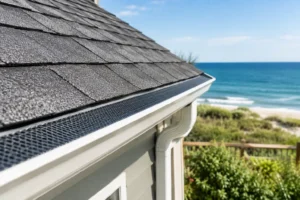
Pine needles create a gutter problem that ordinary screens were never designed to solve. They are narrow enough to pass through wide openings, light enough to collect in corners, and plentiful enough to form dense mats after a windy week. The best pine needle gutter guards use fine stainless-steel micro-mesh to block this debris before it enters the gutter while still allowing rainwater to drain properly.
For homeowners from Myrtle Beach and North Myrtle Beach to Conway, Murrells Inlet, Pawleys Island, and Georgetown, the stakes are higher than a messy gutter. Coastal storms can deliver heavy rainfall in minutes. When needles, roof grit, leaves, and seed pods restrict the drainage system, water can spill over gutters and threaten fascia boards, siding, landscaping, foundations, and crawl spaces.
Why Pine Needles Defeat Basic Gutter Guards
Many gutter guards are built around the idea of stopping large leaves. That is useful, but pine needles demand a more precise barrier. Wide-hole screens and perforated covers may stop branches and oak leaves while letting needles slip directly into the gutter. Once inside, those needles collect around hangers, outlets, and downspouts, where they can catch additional debris and slow water flow.
Brush-style inserts have a different weakness. Pine needles can become tangled in the bristles, creating a layer that must be removed by hand. Foam inserts can catch needles on top, but the porous material may hold moisture and fine roof sediment over time. Neither option eliminates the need for frequent inspection in homes surrounded by pines.
A guard also has to perform during a true Carolina downpour, not only during a light rain. If water overshoots the guard or backs up beneath debris, the gutter system can overflow even when the channel itself is clean. The right material, mesh opening, installation angle, and roof-edge configuration all matter.
What the Best Pine Needle Gutter Guards Have in Common
The most effective systems combine a very fine filtration surface with a durable frame and professional installation. Stainless-steel micro-mesh is particularly well suited to pine-heavy properties because its openings are small enough to keep needles, shingle grit, insects, and other fine debris out of the gutter.
Water behaves differently than debris on a properly installed micro-mesh guard. Rain adheres to the mesh surface and follows it into the gutter, while needles and leaves remain on top where wind and normal drying cycles can help move them away. This does not mean a guard makes every roof completely maintenance-free. Debris can still rest on the surface in heavily wooded areas, especially in roof valleys or behind chimneys. The difference is that the debris stays outside the gutter instead of creating a hidden blockage inside it.
A quality system should also be made for long-term exterior exposure. Coastal homes face humidity, salt air, ultraviolet exposure, wind-driven rain, and repeated temperature changes. A stainless-steel micro-mesh surface resists corrosion better than many lightweight alternatives, while a sturdy supporting frame helps the guard maintain its shape along the roofline.
Look for a system that addresses organic growth as well. Humid weather can encourage algae, mildew, and buildup on any exterior component. GutterGlove systems use anti-microbial technology as part of their gutter-protection design, helping support a cleaner drainage surface over time.
The mesh is only part of the solution
Even the best material can underperform if it is installed incorrectly. Guards should be fitted to the roof edge and existing gutter system so water enters the gutter without creating gaps or areas where debris can collect. The installer should also check the gutter pitch, downspout capacity, end caps, corners, and fasteners before adding protection.
This is especially important for older homes and vacation properties. A guard cannot correct gutters that are pulling away from the fascia, sagging between hangers, or pitched in the wrong direction. Those issues should be repaired first so the protected system can carry water away from the home as intended.
Comparing Common Pine Needle Guard Options
Homeowners often start by comparing price tags, but the better comparison is how each style manages fine debris and high-volume rain.
Basic plastic screens are inexpensive and may reduce leaf buildup, yet their larger openings often allow pine needles and roof grit into the gutter. They can also crack or warp under strong sun and changing weather conditions. They are generally a short-term improvement, not a dependable answer for a pine-covered property.
Perforated metal covers tend to be stronger than plastic screens, but performance varies with hole size. If the openings are large enough for needles to enter, the gutter can still clog below the cover. Some solid-cover designs shed large debris effectively, but their performance depends heavily on the installation angle and the amount of water coming off the roof during intense storms.
Foam and brush guards are easy to find and install, but they keep debris in the gutter system rather than outside it. Pine needles may lodge in the material, and both options can require regular removal and cleaning. They are not usually the best fit for homeowners who want to reduce ladder work over the long term.
Fine stainless-steel micro-mesh systems generally provide the strongest balance for homes with persistent pine needles because they filter the smallest debris while maintaining drainage. Their higher initial cost reflects material quality, system design, and professional installation. For a home exposed to pines, heavy rain, and windblown coastal debris, that investment can reduce recurring cleaning costs and lower the risk of water-related repairs.
Roof Design and Rainfall Still Matter
There is no single guard configuration that is identical for every house. A low-slope roof, a steep roof, a metal roof, and an asphalt-shingle roof shed water at different speeds. A home beneath longleaf pines has a different debris pattern than a home near marshland with oak leaves, palm fronds, and windblown seed pods.
Roof valleys deserve special attention. They concentrate water and debris into a small section of gutter, which can overwhelm any system if the gutter is undersized or the downspout layout is inadequate. In those areas, a specialist may recommend adjustments to drainage components before or alongside guard installation.
Second-home owners should also consider access. A gutter that clogs at a primary residence is inconvenient. A clogged gutter at a home that sits vacant for weeks can allow overflow to continue unnoticed through multiple storms. Reliable guards do not replace periodic visual checks, but they provide a significant layer of protection when no one is available to clear a blockage immediately.
Questions to Ask Before Choosing a Gutter Guard
Before making a decision, ask whether the proposed guard blocks pine needles and shingle grit, not just leaves. Ask how it performs in heavy rain, how it attaches to the roof and gutter, and whether installation includes an inspection of existing drainage problems.
It is also reasonable to ask about material composition, warranty coverage, and who will complete the installation. A long manufacturer-backed warranty has more value when paired with an established local contractor who understands the rainfall patterns and debris conditions around your home.
Clearwater Rain Gutters has served Carolina homeowners since 2006 with professionally installed GutterGlove stainless-steel micro-mesh systems and a 40-year manufacturer-backed no-clog warranty. The process begins with looking at the whole drainage system, not simply placing a cover over a problem gutter.
Protect the Areas Below Your Gutters
The purpose of gutter protection is not merely to avoid cleaning out needles. It is to keep water moving where it belongs: through the gutter, into the downspout, and away from the house. When that path is blocked, the consequences can include rotted wood, stained siding, eroded planting beds, foundation moisture, mold, and water around a crawl space.
If pine needles regularly collect on your roof or in your gutters, schedule a professional inspection before the next period of heavy rain. A clear assessment of your roofline, gutter condition, downspouts, and debris exposure can identify the protection system that will give your home the most dependable long-term drainage.
Leave a Reply
You must be logged in to post a comment.