
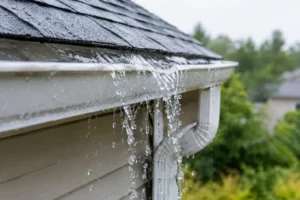
A gutter spilling over the front edge during a Carolina downpour is more than an annoyance. It is water missing its intended path and landing where it can damage fascia, saturate mulch beds, erode soil, and collect near the foundation. Understanding why gutters overflow helps homeowners address the actual drainage problem before one hard rain becomes an expensive exterior repair.
For homes along the Grand Strand, from North Myrtle Beach and Conway to Murrells Inlet, Pawleys Island, and Georgetown, gutters face a demanding mix of tropical rainfall, high humidity, pine needles, oak leaves, roof grit, and wind-driven debris. Overflow may be caused by a simple clog, but it can also point to a sizing, slope, or roof-drainage issue that needs a closer look.
Why Gutters Overflow During Heavy Rain
Gutters are designed to collect runoff from the roof and carry it to downspouts. When water cannot enter the trough, move through it, or exit through the downspout fast enough, it looks for the easiest route out. That route is often over the gutter edge, behind the gutter, or down an exterior wall.
The most common reason is debris accumulation. Leaves, pine needles, seed pods, shingle grit, and small twigs can build up in the gutter channel. A small amount of debris may seem harmless, but wet material compacts quickly. It can create a dense dam that holds standing water and blocks the outlet leading to the downspout.
Clogs inside downspouts are equally common and easier to miss. Water may appear to be moving through the gutter until a heavy storm fills the system faster than the blocked downspout can drain. The gutter then backs up from the outlet and overflows, often at the same location each time it rains.
Rain Can Exceed a Poorly Designed System
Not every overflowing gutter is clogged. Coastal thunderstorms can release a large volume of water in a short period. If gutters are too small for the roof area, if there are too few downspouts, or if downspouts are undersized, the system may not have enough carrying capacity for intense rainfall.
Roof design matters as well. A large roof plane, a steep pitch, or a valley where two sections of roof meet concentrates water into one area. That rushing sheet of water can shoot past a conventional gutter or overwhelm a short run before it reaches an outlet. This is why a solution that works on one side of a home may not be sufficient around a valley, porch roof, or second-story roofline.
A qualified inspection should consider the roof’s drainage pattern, not just whether the gutter contains leaves. Adding a guard to a gutter that is incorrectly pitched or too small will not solve a capacity problem. The system must first be able to collect and direct the amount of water the roof produces.
Other Causes of Overflowing Gutters
Improper slope is a frequent contributor. Gutters should have a subtle, consistent pitch toward the downspout. When a section is level, sagging, or pitched in the wrong direction, water pools instead of moving. Debris settles in that standing water, making the problem worse over time.
Loose hangers, bent gutter sections, damaged corners, and failed end caps can also change how water moves. A gutter pulling away from the fascia may allow water to run behind it. This can stain siding and soak the fascia board, where ongoing moisture may lead to wood rot and hidden repair needs.
In some cases, water is not actually overflowing from inside the gutter. It may be flowing over the roof edge because the gutter is installed too low, too far from the drip edge, or in a position that does not catch fast-moving runoff. Wind can complicate the picture by driving rain beneath roof edges or pushing leaves into one concentrated area.
These distinctions matter. Cleaning alone may help a clogged trough, while a recurring problem may require gutter repair, re-pitching, additional drainage capacity, or a different protection approach.
What Overflow Can Do to a Carolina Home
A single storm does not necessarily mean structural damage. Repeated overflow is different. Water follows the same paths, and those repeated wet-dry cycles can affect several parts of the property.
When water spills near the foundation, it can wash away soil and mulch, create low spots that hold water, and increase moisture around crawl spaces. In humid North and South Carolina conditions, that moisture can support mold and mildew growth and make a crawl space harder to keep dry.
Overflow at the roofline can damage fascia boards, soffits, siding, and exterior trim. Water also may splash against doors, windows, patios, and landscaping. For vacation homes and second properties, the concern is greater because a drainage failure may continue unnoticed through several storms.
There is also a safety cost. When gutters repeatedly clog, homeowners often feel pressured to climb a ladder after every major weather event. Cleaning is sometimes necessary, but frequent ladder work is not a dependable long-term plan for a home surrounded by pine trees or mature landscaping.
How to Tell Which Gutter Problem You Have
The timing and location of the overflow offer useful clues. If water spills from multiple sections after a season of leaf drop, debris is likely a major factor. If it overflows near one downspout while the rest of the system looks clear, a blocked outlet or downspout may be restricting flow.
If the same section overflows only during hard rain, inspect the roof above it. A valley, steep roof plane, or unusually broad section of roof may be sending more water there than the gutter can handle. Overflow behind the gutter, peeling paint near the roofline, or a visibly sagging run can indicate a mounting, pitch, or fascia issue.
Homeowners can safely observe these signs from the ground during or shortly after rain. Avoid leaning a ladder against a wet gutter or trying to clear a blockage during a storm. A professional assessment is the better option when there is visible damage, recurring overflow, or uncertainty about the system’s capacity.
The Right Fix Depends on the Cause
A proper repair begins with clearing the system and confirming that water flows freely through every downspout. From there, a specialist can check slope, fastening, seams, corners, end caps, and the condition of the fascia. If a roof valley creates concentrated runoff, the best answer may involve adjusting the gutter configuration or improving drainage capacity.
For homes where debris is the recurring problem, professionally installed gutter protection can greatly reduce the need for cleaning. Stainless-steel micro-mesh systems such as GutterGlove are designed to keep out leaves, pine needles, roof grit, insects, and small debris while allowing rainwater to pass into the gutter. The fine mesh matters in coastal areas, where pine needles and shingle granules can slip through wider openings and create clogs below the guard.
Quality installation is just as important as the material. The guard must be integrated correctly with the roof edge and gutter so water enters the system rather than running over or behind it. A careful installer also evaluates whether existing gutters are sound enough to protect. Damaged, undersized, or poorly pitched gutters should be repaired or corrected before protection is added.
Clearwater Rain Gutters has served homeowners since 2006 with inspections that account for local rainfall, tree coverage, roof geometry, and existing drainage conditions. For qualified installations, its GutterGlove systems include a 40-year manufacturer-backed no-clog warranty, offering long-term reassurance beyond a temporary cleaning.
When to Schedule an Inspection
Do not wait for a visible leak inside the home. Schedule an inspection if you see water spilling over the gutter edge, soil washing out below rooflines, standing water in gutters after rain, peeling paint near the fascia, or downspouts that appear to drain slowly. An inspection is also worthwhile before hurricane season, after a major storm, or when buying a home with mature trees near the roof.
The goal is not simply to stop an obvious spill. It is to create a drainage system that catches roof runoff, moves it away from the house, and stays functional through the weather and debris your property faces. A free professional inspection can identify whether your home needs cleaning, repair, improved capacity, or durable micro-mesh gutter protection before the next heavy rain tests the system again.
Leave a Reply
You must be logged in to post a comment.