
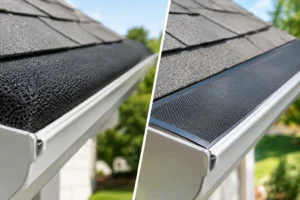
A gutter guard that works reasonably well in a dry, low-debris neighborhood can struggle on the Carolina coast. Tropical downpours, wind-driven leaves, pine needles, roof grit, humidity, and salt-air exposure create a demanding test for every drainage system. When homeowners compare foam guards versus micro mesh, the central question is not simply which product keeps out leaves. It is which system can maintain reliable water flow while protecting the gutter from the small debris that causes clogs over time.
For homes in Myrtle Beach, Conway, Murrells Inlet, Pawleys Island, and surrounding communities, that distinction matters. Overflowing gutters can send water against fascia boards, wash out landscaping, erode soil near the foundation, and contribute to crawl-space moisture. The right guard should reduce routine cleaning while supporting the entire gutter system when heavy rain arrives.
How Foam Gutter Guards Work
Foam guards are porous inserts that sit inside the gutter trough. Water is intended to flow through the foam while leaves and larger debris remain on top, where wind may eventually carry them away or where they can be removed by hand.
The appeal is straightforward. Foam inserts are inexpensive, widely available, and can often be placed in a gutter without specialized tools. For a homeowner looking for a quick, temporary improvement before selling a property or addressing a short-term debris problem, foam can seem like a practical choice.
The limitation is that foam occupies a significant portion of the gutter’s interior. Your gutter is designed to collect and move water. Filling much of that channel with a porous material changes how it handles runoff, especially during the intense rain common along the Grand Strand.
Why foam can become a maintenance issue
Foam is exposed to everything the roof sheds: fine roof granules, decomposing leaves, pine pollen, seed pods, and organic residue. Small particles can lodge in the pores rather than passing through the system. Over time, the top of the foam may become a damp layer of debris where vegetation can take hold.
Humidity compounds the concern. A material that stays wet after a storm can hold moisture against the gutter and collect organic buildup. Foam products vary in quality, but none eliminate the need to inspect the gutter channel beneath them. When the foam becomes clogged, water may skim across its surface, spill over the gutter edge, or back up toward the roofline.
Foam also requires homeowners to remove the insert for a meaningful gutter cleaning. That can turn a product purchased to avoid ladder work into another component that needs periodic handling, cleaning, and replacement.
Foam Guards Versus Micro Mesh in Heavy Rain
The biggest difference between foam guards versus micro mesh is where each system manages debris. Foam attempts to filter water from inside the gutter. Micro mesh covers the gutter opening and keeps debris above the drainage channel in the first place.
A professionally installed stainless-steel micro-mesh guard uses a finely woven surface to admit rainwater while blocking leaves, pine needles, shingle grit, insects, and other small debris from entering the gutter. The gutter remains open underneath the guard, preserving its capacity to carry runoff toward the downspouts.
That design is especially valuable during a hard coastal storm. Instead of asking water to pass through a thick insert that may already contain sediment, micro mesh directs water through a clean screening surface and into an unobstructed gutter. Installation details still matter. The guard must be properly secured, aligned with the roof edge, and matched to the pitch, gutter condition, and drainage needs of the home.
Fine debris is where the comparison becomes clear
Large oak leaves are visible and relatively easy to remove. The more persistent gutter problem is often the material homeowners barely notice: pine needles, roofing granules, pollen residue, small seed debris, and damp leaf particles.
Foam can trap those materials within its pores. Micro mesh is designed to stop them at the surface so they do not build up inside the gutter or downspout. Debris may still collect on top of any guard during certain seasons, particularly beneath pine trees, but it is generally exposed to wind and rain rather than embedded throughout the drainage channel.
A quality micro-mesh system is not a promise that no leaf will ever land near your roofline. It is a more durable approach to preventing the type of internal blockage that causes hidden overflows and recurring cleaning needs.
Material Durability Matters on the Carolina Coast
Price is often the reason homeowners initially consider foam. The lower purchase cost can be attractive, particularly for a second home or rental property where maintenance is already difficult to coordinate. But the better value is determined by service life, maintenance demands, and the cost of a drainage failure, not the initial price alone.
Foam inserts can deteriorate from ultraviolet exposure, weather cycles, and repeated saturation. As the material breaks down or compacts, it may need replacement. A homeowner could face recurring product costs while still paying for gutter cleaning and repairs if debris has accumulated below the insert.
Stainless-steel micro mesh is built for long-term exterior exposure. Premium systems such as GutterGlove use surgical-grade stainless steel micro mesh and a durable frame designed to support the screen and maintain its shape. This is a more substantial installation than placing an insert in a gutter, which is why professional assessment and workmanship are important.
A micro-mesh system should also be evaluated as part of the full drainage assembly. Loose hangers, undersized downspouts, damaged corners, leaking end caps, or gutters pitched incorrectly can still cause water problems. Guards improve gutter protection, but they cannot correct structural or drainage defects that are already present.
When Foam Guards May Make Sense
Foam guards are not automatically the wrong choice. They can make sense as a low-cost, short-term option on a small structure with light debris exposure, easy ladder access, and homeowners willing to inspect and maintain the gutters regularly. They may also provide a temporary measure while a more permanent repair or guard installation is being planned.
They are less suitable for homes surrounded by pines, properties with heavy roof-grit shedding, or residences exposed to frequent hard rainfall. They are also a poor fit for homeowners who selected gutter protection specifically to reduce the risks of climbing ladders. If the foam needs frequent removal and cleaning, it does not solve the maintenance problem that prompted the purchase.
For vacation homes and second properties, dependence on regular inspection can be an even greater drawback. A clogged foam insert may go unnoticed until an owner arrives and sees stained siding, washed-out mulch, or water damage near the roof edge.
Choosing the Right Protection for Your Home
The most reliable answer depends on your roof design, tree coverage, gutter condition, and local rainfall pattern. A home in a wooded part of Conway has different debris pressure than an open coastal property in North Myrtle Beach. A steep roof can shed water differently from a low-slope roof. One downspout serving a long gutter run may need attention regardless of the guard type selected.
A professional inspection should look beyond the visible leaves. It should assess whether gutters are securely fastened, properly pitched, free of leaking seams, and sized to manage the roof’s runoff. It should also identify where water is currently overflowing and whether downspouts are moving water safely away from the foundation.
For homeowners seeking a lasting reduction in gutter maintenance, stainless-steel micro mesh is typically the stronger investment. It preserves more of the gutter’s water-carrying capacity, blocks finer debris, and avoids placing a moisture-holding filter inside the channel. Clearwater Rain Gutters pairs this type of protection with a customized installation approach and a 40-year manufacturer-backed no-clog warranty.
Before the next season of heavy rain, look closely at where your gutters discharge and what collects along the roofline. A free inspection can turn those early warning signs into a clear plan for protecting your home, your landscaping, and the structure beneath them.
Leave a Reply
You must be logged in to post a comment.